

Linear vs. CTV: Why Agencies are Trading Old-School GRPs for Streaming Precision
Linear vs. CTV: Why Agencies are Trading Old-School GRPs for Streaming Precision
![[HERO] Linear vs. CTV: Why Agencies are Trading Old-School GRPs for Streaming Precision](https://cdn.marblism.com/zWFwipnH58W.webp)
You’ve heard the pushback before. You’re sitting across from a client: maybe a local law firm, a regional auto group, or a political candidate: and you suggest moving a portion of their broadcast budget into Connected TV (CTV).
Then comes the dreaded response: "But I want to see my ad on the 6:00 PM news! How do I know people are actually seeing this if we aren't using GRPs?"
It’s time to change the conversation.
The old way of buying television was built on estimates, "spray and pray" tactics, and a measurement system that hasn't evolved since the disco era. Linear TV relies on Gross Rating Points (GRPs) and Cost Per Point (CPP): metrics that tell you how many people might have been in the room.
CTV changes the game. We aren't talking about "points" anymore. We are talking about confirmed impressions, household-level precision, and the ability to reach every single demographic: including the "unreachable" Boomers: exactly where they are watching.
If your agency is facing pushback, here is the data-backed roadmap to winning the argument and moving your clients into the future of programmatic advertising.
1. The GRP Trap vs. The Precision of CPM
For decades, the industry lived and died by the GRP. It’s a simple formula: Reach x Frequency. But in 2026, "Reach" in the linear world is a moving target.
When you buy a "point" in linear TV, you are buying an estimate based on a tiny sliver of the population (the "Nielsen families"). You are paying for everyone in a geographic zone to see your ad, regardless of whether they are actually your target customer.
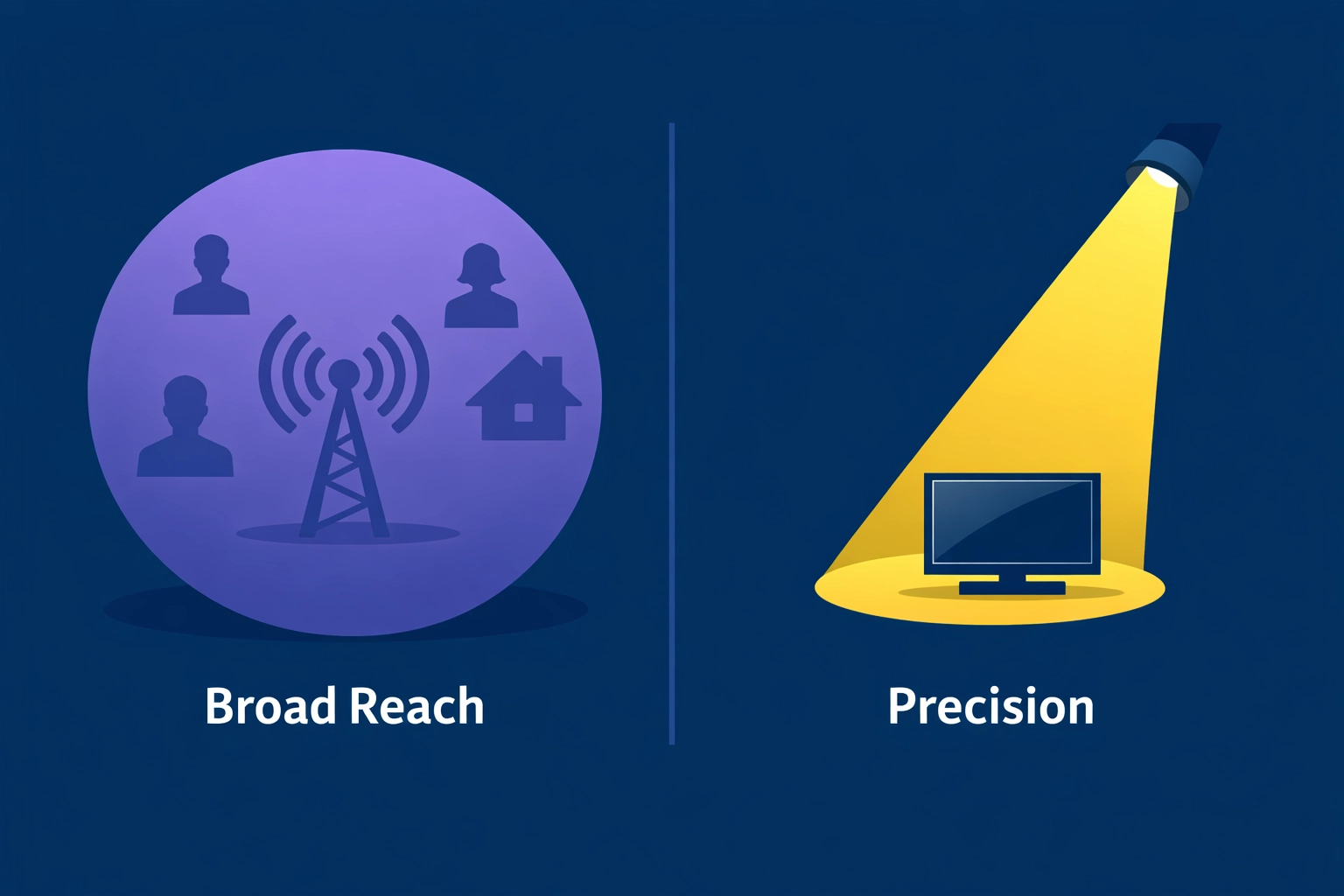
Linear TV is a blunt instrument. CTV is a scalpel.
In the world of CTV and programmatic advertising, we trade the GRP for the CPM (Cost Per Mille/Thousand). Here is why that is a massive win for your agency:
- Zero Waste: On linear, if you want to reach "Luxury Car Buyers," you buy the news and hope they’re watching. With CTV, you use data from partners like L2 or Tunnl to target only luxury car buyers. You only pay for the impressions served to the right people.
- Actual Attribution: You can’t click a linear ad. You can’t easily track if a linear ad led to a website visit. With CTV, we track "view-through" conversions. We know if a user saw the ad on their big screen and then researched the brand on their laptop ten minutes later.
- Real-Time Optimization: If a linear spot isn't working, you’re stuck. With a meta DSP like Conquest, if an ad isn't performing on one streaming app, our AI shifts the budget to another exchange in real-time.
2. The Cost-Per-Point (CPP) Lie
Agencies often use CPP to show "efficiency." But how efficient is it to pay for 100,000 impressions when only 10,000 of them are actually your target audience?
When you compare the "all-in" cost of reaching a specific consumer, CTV wins every single time.
- Linear: You pay for the whole haystack to find the needle.
- CTV: You just buy the needles.
By utilizing Conquest DSP’s meta-platform approach, your agency can access inventory across every major exchange (Hulu, Sling, Paramount+, Roku, and more) to find the lowest possible clearing price for those "needles." You aren't beholden to a single station's inflated rate card. You are buying at the true market price.
CPP vs. CPM: The Math That Ends the Debate
You don’t need a media math PhD to translate linear TV into CTV.
Here’s the conversion your clients instantly understand:
- Linear TV CPP:$2,000 CPP = you “buy” 1 rating point(1% of the market).
- Market size example: 3,000,000 people.
- Impressions equivalent: 1% of 3,000,000 = 30,000 impressions.
Now price it like CTV:
- CTV CPM example:$45 CPM (cost per 1,000 impressions).
- Cost for 30,000 impressions:(30,000 / 1,000) × $45 = $1,350.
Same volume. Lower cost. Way more control.
And it gets better: those CTV impressions can be targeted(not wasted), frequency-capped, and measured with real reporting. That’s why CTV isn’t “spray and pray.”
It’s precision media.
3. Breaking the "Boomer Myth"
The biggest objection to CTV usually sounds like this: "My customers are older. They don't stream. They still watch the evening news on cable."
That argument is dead.
As of 2026, the "Silver Tsunami" has officially moved to streaming. And the stats are loud:
- Nielsen reported in 2025 that streaming hit nearly 45% of total TV viewing (44.8%), eclipsing broadcast + cable combined for the first time. Source: https://www.nielsen.com/news-center/2025/streaming-reaches-historic-tv-milestone-eclipses-combined-broadcast-and-cable-viewing-for-first-time/
- AARP found in 2025 that 66% of adults 50+ embrace technology for a better lifestyle. Source: https://www.aarp.org/pri/topics/technology/internet-media-devices/2026-technology-trends-older-adults/
- MIDiA Research calls them “Silver Streamers” and tags them as the fastest-growing binge-watching demographic. Source: https://midiaresearch.com/blog/the-d2c-challenge-of-engaging-the-silver-streamers
Translation: Boomers aren’t “unreachable.” They’re just not on your client’s cable rep’s rate card anymore.
And here’s the real win for your agency: on linear, you’re bidding against every pharma and insurance brand on the planet during the 6:00 PM news. On CTV, you can reach the same audience inside premium streaming environments—with household-level targeting and clean frequency control.
If your client wants to reach voters or high-net-worth retirees, using specialized data like Tunnl allows you to find them based on behavior and interests, not guesswork and age buckets.
4. Reach and Frequency: Taking Back Control
In the linear world, frequency is a nightmare to manage. A viewer might see your ad five times in an hour because they are watching one specific channel, while another viewer never sees it at all. This leads to "ad fatigue" for some and "zero awareness" for others.
CTV solves the frequency problem.
Because CTV is programmatic, we can set "Frequency Caps" at the household level. You can tell the platform: "Do not show this ad to this household more than three times per week."
This allows your agency to:
- Stretch Budgets Further: Stop wasting money showing the same ad to the same person 20 times.
- Increase Reach: Take those saved impressions and serve them to new households.
- Better User Experience: Your client’s brand stays fresh and relevant, not annoying.
For agencies looking to master the beginner’s guide to buying streaming ads, frequency control is the "secret sauce" that makes clients look like geniuses.

5. Why Conquest DSP is the Agency Secret Weapon
Most DSPs were built for the "Big Guys": the global agencies with $100k monthly minimums. If you’re trying to figure out how to buy streaming ads locally for a client with a $2,000 budget, those platforms will slam the door in your face.
We do things differently.
Conquest DSP was built specifically to empower independent agencies. Here is how we help you win the Linear vs. CTV battle:
- No Minimums. Ever: Want to test a CTV campaign for $500? Do it. We believe every business deserves to be on the big screen.
- The Meta-DSP Advantage: Don't limit yourself to one exchange. We plug you into everything. If the inventory exists, we can buy it. This ensures you always get the best reach and the best price.
- Proprietary Data: We prioritize high-impact data partnerships. While others talk about general demographics, we give you access to Tunnl(for deep-dive issue and political targeting) and L2(the gold standard in consumer and voter data).
- The Dividend Program: We actually reward your growth. As your agency scales, you can earn cash-back dividends that go straight to your bottom line.
6. How to Pivot the Conversation Today
The next time a client asks about GRPs, give them this three-step response:
- Acknowledge the goal:"I understand you want to ensure we are reaching a large audience."
- Introduce the precision:"Linear GRPs are like a billboard in a fog. You know it's there, but you don't know who saw it. CTV CPMs are like a direct mail piece sent only to people who are currently looking to buy what you sell, and at a fraction of the price of mail"
- Show the proof:"With CTV, I can show you exactly how many people watched the ad to completion, how many unique households we hit, and even how many of them visited your site afterward. Can your cable rep do that?"
The Verdict: CTV is the Clear Winner
Linear TV isn't going to disappear tomorrow, but its dominance is over. For agencies, the shift to CTV isn't just a technological upgrade: it's a survival strategy.
By moving from the estimated "points" of the past to the verified "impressions" of the future, you provide your clients with better targeting, better measurement, and ultimately, a better ROI.
Are you ready to stop guessing and start winning?
Whether you are a seasoned pro or looking for a small business guide to local streaming, Conquest DSP has the tools, the data, and the support to help your agency thrive in the programmatic era.
Meet with our team today and let’s get your clients on the big screen.
Conquest DSP Blog